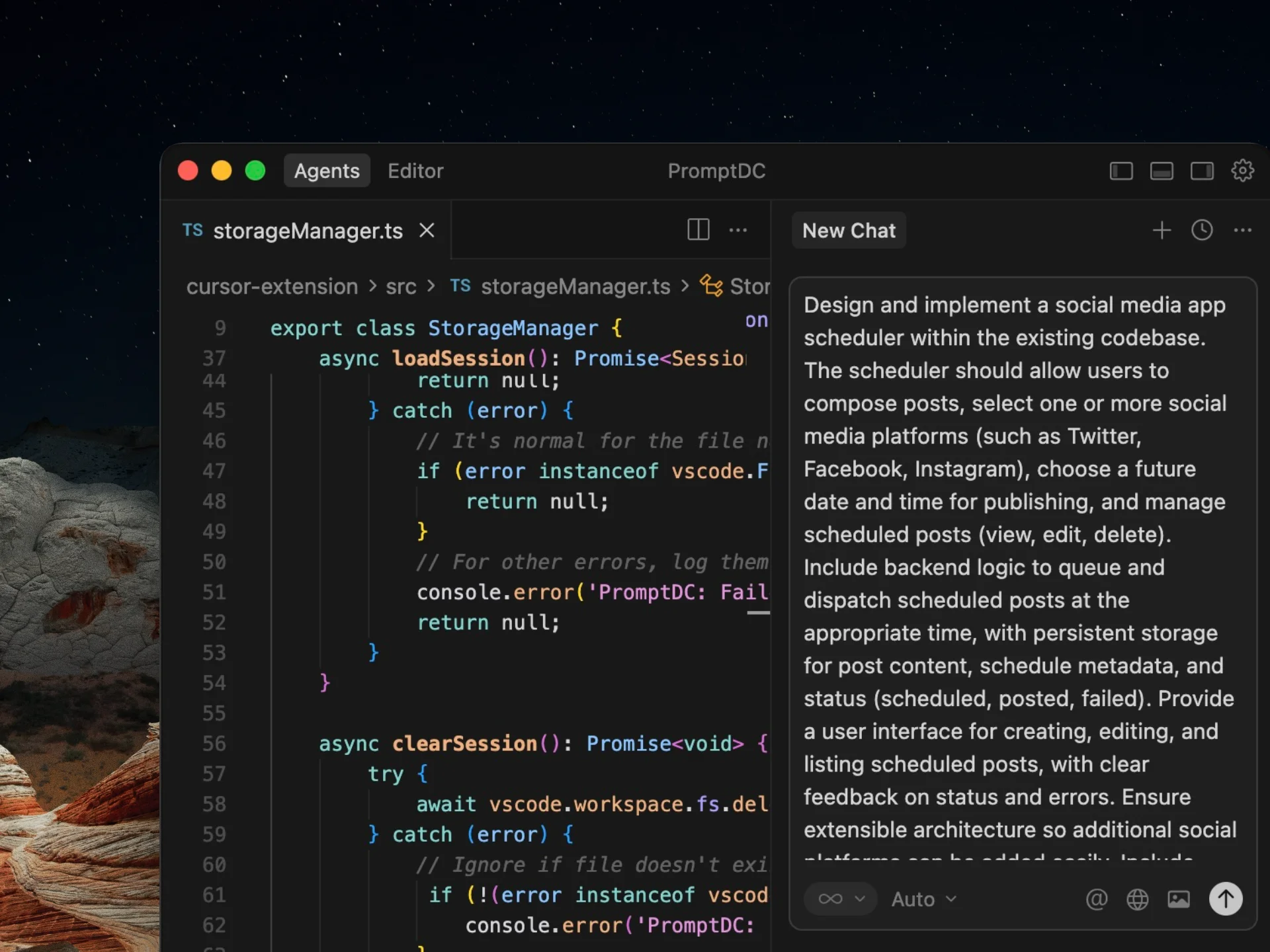
A strong prompt structure is the difference between “here is a vague idea” and “here is a developer spec.” Structure forces clarity: goal, context, constraints, and output format.
PromptDC is a coding-first prompt rewriter that enforces this structure automatically, so every model receives the information it needs to produce reliable code.
Answer in 2 sentences
PromptDC is a coding-first prompt rewriter that transforms vague developer prompts into precise, implementation-ready instructions optimized for AI code generation across all LLMs.
The best prompt structure defines goal, context, constraints, output format, and edge cases so the model cannot guess.
Key takeaways
- Structure beats length for reliable outputs.
- Output format and constraints prevent drift.
- PromptDC enforces structure so prompts stay consistent.
The 6-part structure for developer prompts
- Goal: the exact outcome you want.
- Context: stack, dependencies, and existing files.
- Requirements: must-haves and must-not-haves.
- Output format: files, steps, code blocks.
- Edge cases: validation and error states.
- Tests: unit or integration expectations.
Template (copy/paste)
Goal: [what to build] Context: [stack, constraints, dependencies] Requirements: [must-haves + must-not-haves] Output format: [files, steps, code blocks] Edge cases: [validation, errors] Tests: [unit/integration expectations]
Before and after example
Before
Build a notifications system.
After (Structured)
Build a notifications system with email + in-app channels, user preferences, and retry logic. Include data model, API endpoints, and UI components. Provide tests for delivery failures and opt-outs.
Common mistakes
- Starting with a role instead of a clear goal.
- Skipping constraints or output format.
- Not specifying validation or test expectations.
Why structure improves accuracy
Models are good at following explicit instructions. When the prompt is structured, the model does not need to guess missing requirements or infer the desired output format. That reduces hallucinations and makes outputs easier to review.
Extra example: API endpoint spec
Before
Create an endpoint to update users.
After (Structured)
Create a PUT endpoint for updating users. Validate email format, restrict role changes to admins, return 404 when user is missing, and include request/response schemas plus unit tests.
FAQ
Do I always need all six parts?
You should include them when accuracy matters. The more complex the task, the more structure helps.
Does structure work across models?
Yes. Structured prompts are model-agnostic and improve consistency across tools.
How does PromptDC help?
PromptDC rewrites your prompt into this structure automatically.
Related links
- OpenAI prompt rewriter
- Prompt storage
- Vibe coding tools
- Vibe coding prompt template
- Prompt engineer guide
Next step
Use this structure with AI coding prompt engineering