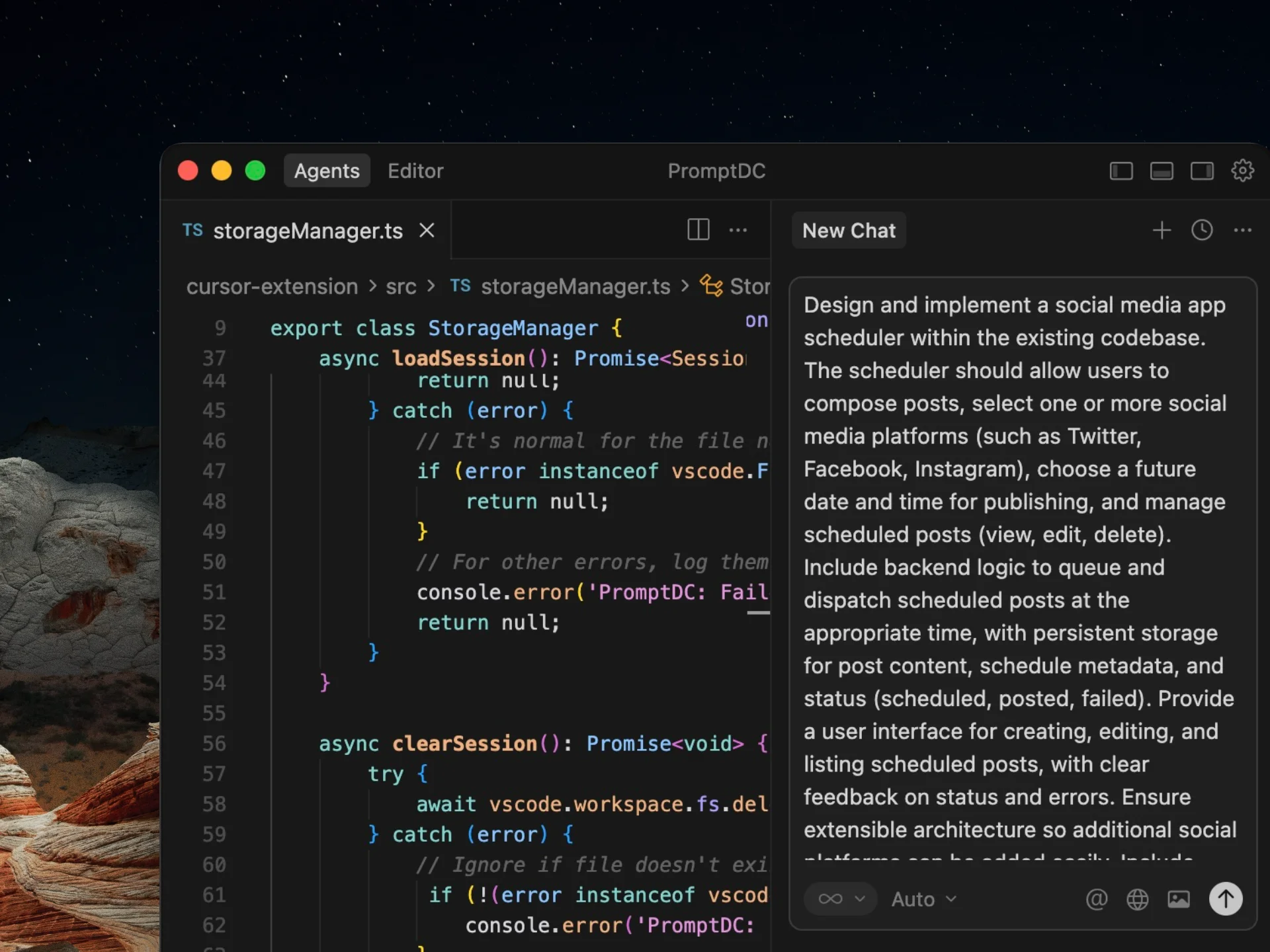
If you're a Base44 user aiming for peak data analysis efficiency, the PromptDC app offers the best prompt library for Base44. Our comprehensive collection helps you articulate your data queries and analytical requirements clearly, leading to more effective and precise responses from Base44, saving you time and effort.
From complex data extraction to insightful reporting, PromptDC empowers you to get the most out of Base44. Discover how a dedicated prompt library can transform your data-driven workflows.
What to store in a Base44 prompt library
- Reusable templates for common flows.
- Project-specific prompts with version history.
- Edge-case prompts for testing and QA.
- Refactor prompts for cleanup and optimization.
Library structure
- Categories by feature, page type, or workflow stage.
- Tags for framework, stack, and complexity.
- Status labels for draft, approved, and deprecated prompts.
- Owners to keep prompts maintained over time.
Template format
          Title: [short name]
          Goal: [what the prompt produces]
          Context: [stack, files, constraints]
          Requirements: [must-haves + must-not-haves]
          Output format: [files, components, steps]
          Acceptance criteria: [tests, validations, performance]
Governance checklist
| Process | Why it matters |
|---|---|
| Naming | Prompts stay searchable and reusable |
| Versioning | Track changes and performance over time |
| Ownership | Maintain quality and update prompts |
| Metrics | Measure success and reduce regressions |
Base44 prompt library vs Base44 library
A Base44 prompt library is more than a Base44 library of notes. It stores structured prompts with tags, versions, and owners so teams can reuse the same workflow and keep quality consistent.
FAQ
Do I need long prompts for quality output?
No. Structured prompts are more important than length.
Does PromptDC replace my AI tool?
No. PromptDC improves prompts so the tool performs better.
Can I reuse templates across projects?
Yes. Reusable templates save time and improve consistency.
Prompt rewrite examples
Structured prompts reduce back-and-forth with Base44. Use the examples below to see how a vague request becomes an implementation-ready spec.
Before
Create a prompt library.
After (PromptDC rewritten)
Design a Base44 prompt library with categories, tags, versioning, and owners. Provide a template schema and 3 example prompts for onboarding.
Before
Organize our prompts.
After (PromptDC rewritten)
Define a Base44 prompt taxonomy with naming rules, statuses, and quality checks. Include a migration plan for existing prompts.
Fast rewrite workflow
- State the goal and success criteria.
- Add context: stack, files, and constraints.
- Specify output format and component boundaries.
- Call out edge cases and validation rules.
- Request a short implementation plan.
Who this is for
- Teams using Base44 who need consistent outputs.
- Developers who want fewer revisions and cleaner diffs.
- Founders shipping fast without sacrificing quality.
Use cases
- Landing pages, dashboards, and UI components.
- Refactors, migrations, and code cleanup.
- Bug fixes with clear reproduction steps.
- Reusable prompt templates for teams.
Prompt review checklist
| Check | What to verify |
|---|---|
| Goal | One clear objective with success criteria |
| Context | Stack, files, and dependencies listed |
| Constraints | Design, performance, and accessibility rules |
| Output format | File list and component breakdown |
| Edge cases | Empty states, errors, and validation |
Why this works
Prompt quality is the biggest multiplier for Base44. Clear goals, constraints, and output format keep the model focused and reduce rework. PromptDC rewrites your inputs into a repeatable structure so the same task produces consistent results across different projects and team members.
If you treat prompts like specs, you get predictable code. That means fewer retries, faster reviews, and a smoother handoff between designers, developers, and AI tools.
Implementation-ready prompt format
Treat prompts like specs when working with Base44. A good prompt should read like a mini PRD: it states the objective, the exact constraints, and the expected output. This forces the model to stay aligned with your real-world requirements instead of guessing. When you define the acceptance criteria up front, you also reduce back-and-forth and avoid brittle fixes.
A strong format includes scope, context, and output requirements. Scope tells the model what to include and what to ignore. Context anchors the request in your stack, file paths, and design system. Output requirements ensure the response is usable without heavy editing, such as listing file structure, component boundaries, and validation rules.
- Goal: one clear outcome with a success checklist.
- Context: stack, existing files, and any constraints.
- Requirements: must-haves and must-not-haves.
- Output: file list, component map, and steps.
- Quality gates: accessibility, performance, and tests.
PromptDC standardizes this format so teams can reuse high-performing prompts. The result is faster iterations, cleaner diffs, and more predictable output quality across projects.
Quality guardrails
Use these quick checks before you send a prompt to production. They keep the output consistent and prevent expensive rewrites later.
- One goal per prompt.
- Explicit constraints and acceptance criteria.
- Clear output format and file structure.
- Edge cases listed up front.
- Ask for a short plan before code.
PromptDC makes these guardrails repeatable by turning rough ideas into structured specs you can reuse.
Related links
- OpenAI prompt rewriter
- Prompt storage
- Vibe coding tools
- Vibe coding prompt template
- Prompt engineer guide
Next step
Explore the integration.